

- Client
- DStv
- Sector
- Broadcast & media
- Origin's role
- UX & UI design, desktop media player, connected-decoder interface
- Desktop media player
- Streaming & downloads
- Three-tier catalogue
- Wallet & rentals
- 10-foot TV interface
The challenge
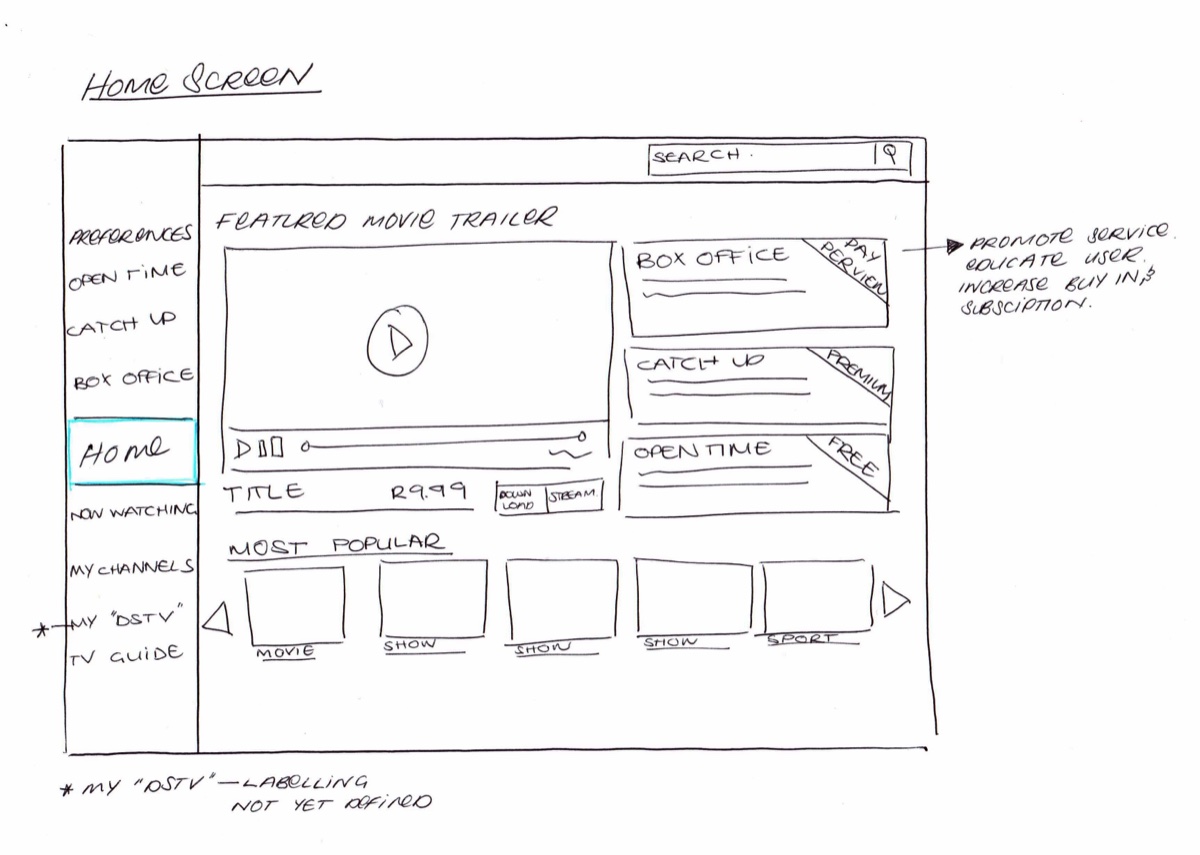
DStv Online was opening a catalogue of on-demand video across three tiers of access: BoxOffice for paid rentals, Catch Up for shows a subscriber had recently missed, and Open Time, a free tier open to anyone, subscriber or not. Three kinds of viewer sat across those tiers too, an existing DStv and MWEB subscriber with the full catalogue, a pay-as-you-go TVOD user with BoxOffice and Open Time only, and a free user limited to Open Time. Origin was briefed to design the desktop media player that would carry all three, a piece of software a subscriber would install to stream or download film and TV to a PC or Mac, built to sit convincingly next to the on-demand website and the decoder interface taking shape alongside it.
A media player brings its own competition. The brief was explicit that it had to read as slick and fast as the players people already trusted, BBC iPlayer, Boxee, XBMC, while carrying paid rentals, a live wallet balance and a download manager that none of those needed to. The real problem was making three tiers of access, two ways of paying and both a remote and a mouse as an input read as one calm product rather than three bolted together.
Our approach & thinking
Origin worked from the access model outward rather than from a single screen. The three tiers, the three kinds of viewer and the two very different inputs, remote and mouse, were mapped before any interface was drawn, then expressed once for the player and once for the decoder.
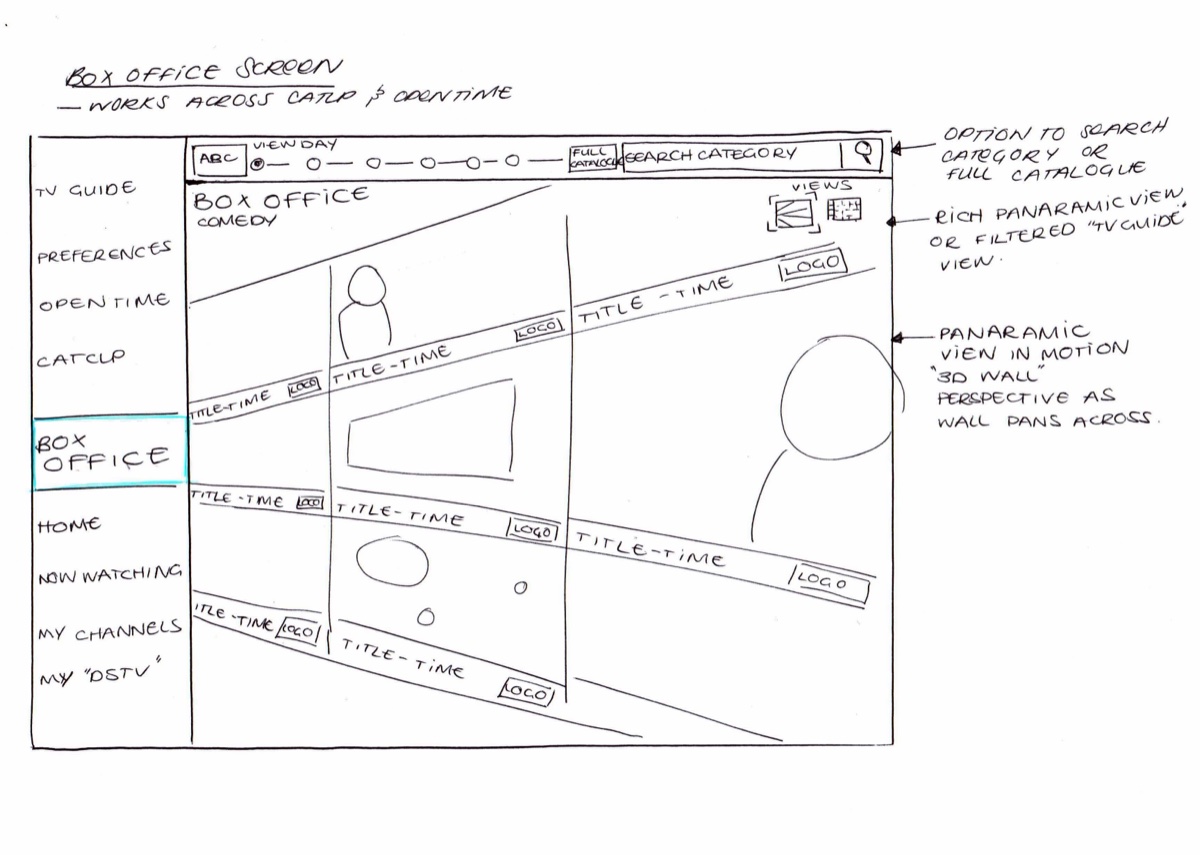
Discovery works three ways. A user journey through the catalogue is sorted by title, air date or rating, filtered by genre, A-Z or scheduled time, and searched by an autocomplete word wheel, so the same film can be found however a subscriber thinks of it.
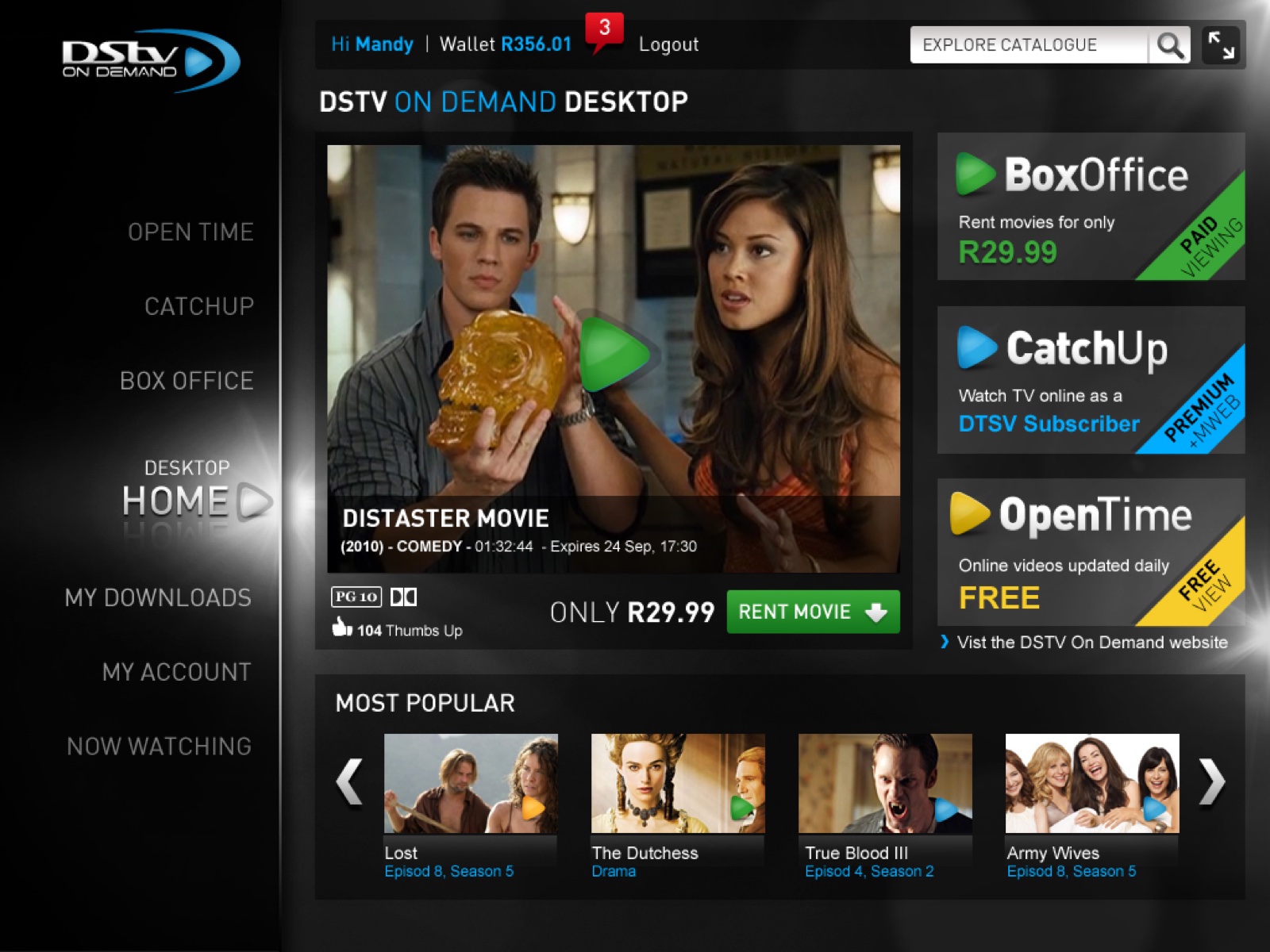
The wallet is always visible. A rand balance sits permanently in the top bar next to the subscriber's name, with a top-up flow that never interrupts browsing, so a rental never surprises anyone at the point of confirming it.
Live, Catch Up and BoxOffice stay distinct. Each tier keeps its own colour, its own price logic and its own browse grid, a recency window for Catch Up, a rental price for BoxOffice, rather than being flattened into one shared list.
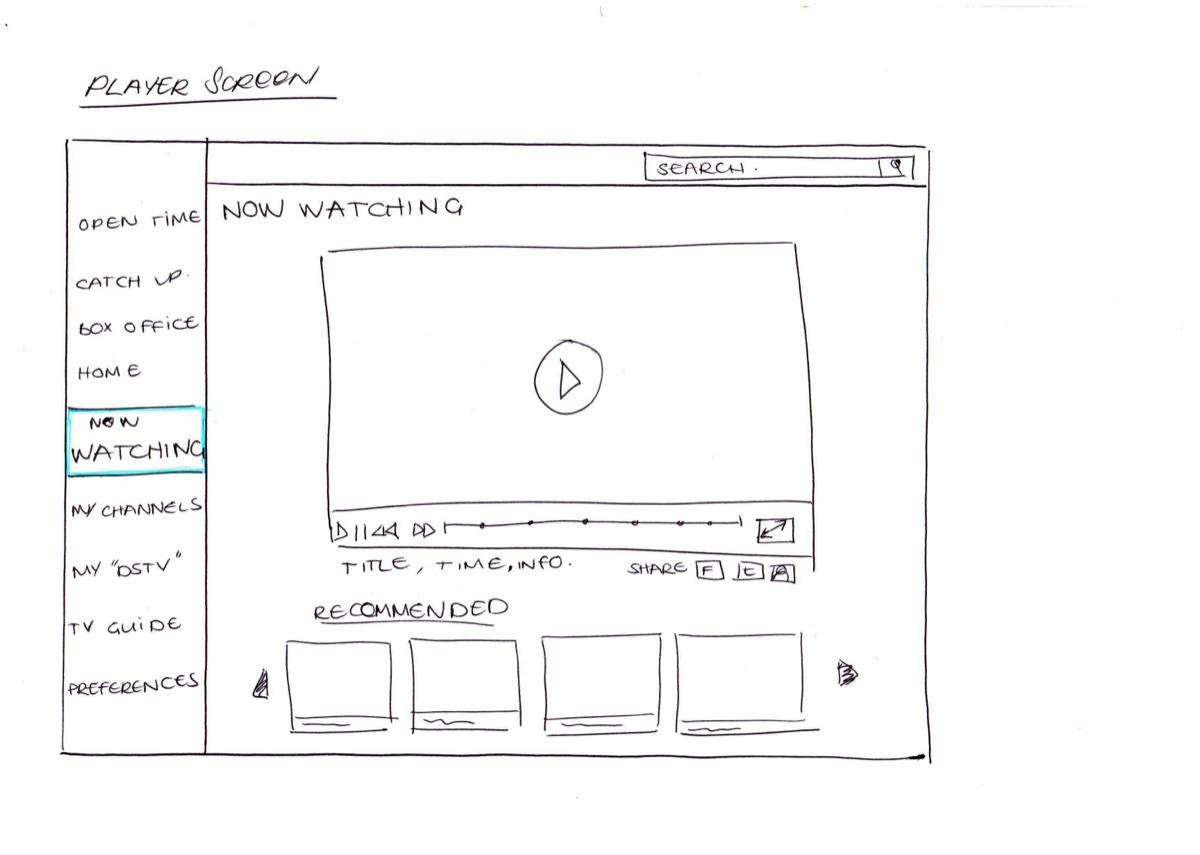
One navigation logic, two inputs. The decoder's Cross Shifting concept, moving through rich functionality with only the remote's arrows and OK button, was carried across as the same underlying logic the player expressed with a keyboard and a mouse.
What we shipped
A desktop media player, installed by subscribers, streaming or downloading BoxOffice rentals, Catch Up replays and Open Time's free video from one catalogue and one account. A My Downloads screen tracks every active download's progress and speed, pauses and resumes it, counts down an expiry once a rental is watched, and keeps a watchlist alongside the queue. The connected-decoder interface carried the same three tiers through a graphic language the brief called Chic and Tech, built around the Cross Shifting navigation model.
BoxOffice and Catch Up browse the same way, a grid sortable A-Z or by rating and filterable by genre, with a download's progress bar shown in place on its own tile. Open Time keeps its own free-view colour and catalogue for viewers with no subscription at all. Both the player and the decoder were designed to hold up as the catalogue kept growing.
Outcome & value
DStv Online could offer three tiers of paid and free video, subscriber, TVOD and free, through one desktop player instead of three separate products, with a visible wallet and a download manager that made a rental feel as ordinary as changing channels. The Cross Shifting navigation and the tiered catalogue carried through into the connected-decoder build taking shape alongside it.
Had the wallet and the download states been designed screen by screen rather than from the access model outward, a subscriber moving between BoxOffice, Catch Up and Open Time would have met three different ideas of what free and paid meant, rather than one product with three doors in.
In summary

Next steps
Does your product need to work on the television as well as the browser?
Let's talk about it.
Tell us what you're working on, what you're trying to achieve, what isn't working, or where you think there's an opportunity.